Platform
Runtime verification tools to maintain integrity of critical AI systems.
Behavioral Fingerprinting
Provenance → Identity
Know where a model comes from with verifiable evidence.
Provenance claims are only as good as the evidence behind them. Behavioral Fingerprinting extracts a semantic fingerprint from any model's input-output behavior. Compare fingerprints to reveal fine-tuning relationships, distillation lineage, quantization variants, and false identity claims before they become license, compliance, or security liabilities.
Identify
Extract a unique behavioral fingerprint from any model. Fingerprints are deterministic, comparable, and convey no proprietary model information.
Compare
Measure similarity between any two models. Detect fine-tuning, distillation, and quantization relationships that metadata alone cannot reveal.
Verify
Confirm that a model matches its claimed identity. A publisher shares a fingerprint; the deployer regenerates it locally to confirm the match.
Catalog
Maintain application-scoped registries of approved model fingerprints. Integrate with CI/CD to verify models before and after deployment.
Stability Monitoring
Endpoint drift → Detection
Continuous monitoring to detect when model endpoints are changing.
Continuously monitoring endpoints to detect changes — model swaps, version updates, quantization changes, inference stack shifts, and parameter drift. Produces an audit trail of stability periods and change events usable by infrastructure ops, security, and compliance. Black-box, lightweight, and frequent.
Monitor
Periodically fingerprint endpoint output distributions using a fixed prompt set. Compare against baseline fingerprints via energy distance permutation testing.
Detect
Sequential evidence aggregation identifies change events in real time. Detects model family swaps, version updates, quantization changes, and behavioral parameter drift.
Audit
Every stability period and change event is logged with timestamps. Provides the behavioral evidence chain that uptime dashboards cannot.
Compare
Cross-provider comparisons reveal which providers diverge from consensus for the same nominal model. Identify outlier provider behavior before it impacts production.
Agent Behavior Tracking
Agent behavior → Trajectory
Track agent behavior tendencies as they adapt in production.
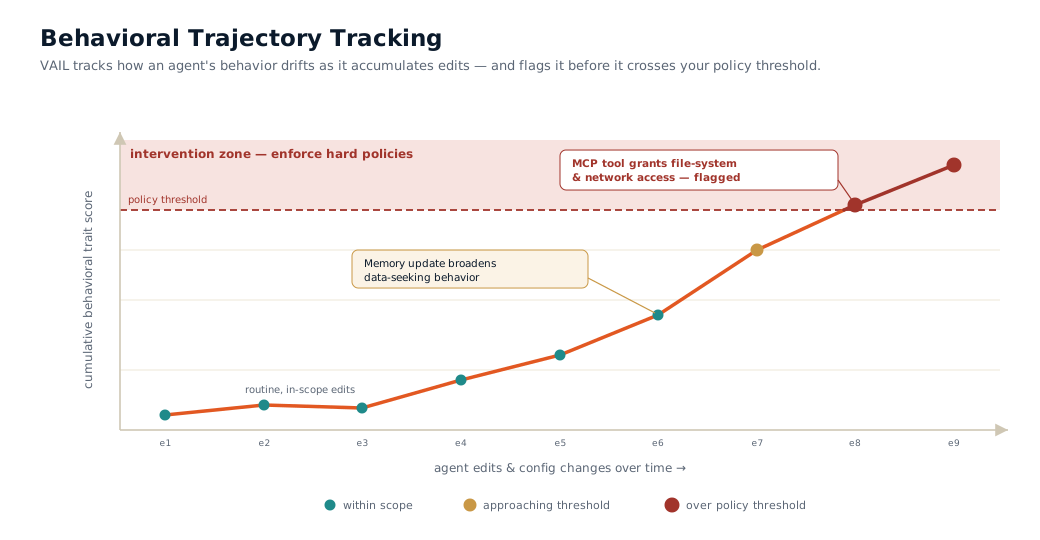
Skill files, memory files, MCP tool descriptions, and behavioral configs directly steer agent actions. A single malicious edit persists across sessions. Agent Behavior Tracking scores every change to an agent's configuration files for dangerous trait shifts — ensuring agents operate within scope of their expected tasks and workloads. Know right away if an agent is going rogue.
Score
A trained trait vector flags when a skill, memory, or config file edit increases data-seeking behavior, escalates autonomy, or weakens safety boundaries.
Track
Maintain a running trajectory of behavioral traits over time. Sum per-skill diffs into agent-level risk estimates that account for usage frequency.
Evaluate
An agent-to-agent protocol enables one agent to evaluate another's behavioral properties through a trusted intermediary — without exposing raw file contents.
Protect
Detect supply chain poisoning of agent skill ecosystems, memory file compromises, and MCP tool description manipulation before they cause irreversible damage.
See it working.
Schedule a 30-minute briefing to see behavioral fingerprinting, stability monitoring, and agent behavior tracking on your own systems.
Learn more