Technology
Our work in Model Informatics and verifiable computation has produced the core technologies behind our products. Behavioral fingerprinting and verifiable computation for LLMs are available today.
Behavioral fingerprinting
Behavioral fingerprinting identifies and verifies AI models by how they behave. Instead of relying on model weights or architecture, it creates a verifiable fingerprint from a model’s behavior during inference, which gives visibility and control over AI deployments in any environment.
Each model has distinctive behavioral patterns that can be captured in a compact fingerprint, much as DNA identifies an organism. We analyze behavior during actual inference, capturing subtle differences in how models process and respond to inputs.
Model similarity and lineage tracing
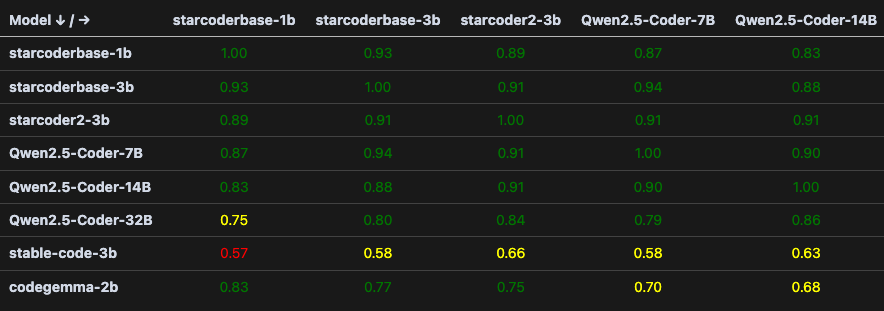
Behavioral fingerprints enable precise similarity analysis between models, revealing relationships that architecture alone does not show. Measuring behavioral similarity traces the fine-tuning and distillation that connect one model to another.
This lets researchers and organizations understand a model’s lineage, identify derivative works, and keep attribution and compliance in order.
Verifiable computation for LLMs
VAIL collaborated with Daniel Kang and his team at the University of Illinois Urbana-Champaign on ZkTorch, a zero-knowledge proof system for large generative AI models. It verifies model computations cryptographically without revealing model details or training data.
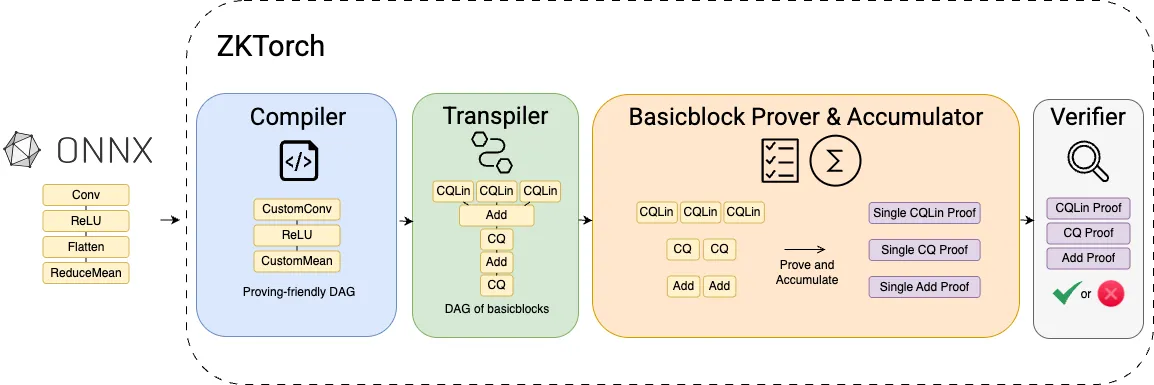
ZkTorch compiles ML models into base cryptographic operations called basic blocks, each proved with a specialized protocol, and is built on a parallel extension to the Mira accumulation scheme.
It produces proofs 3× smaller than specialized protocols such as Mystique and zkCNN, proves up to 6× faster than general-purpose ZKML frameworks, was the first to generate end-to-end proofs for every model in the MLPerf Edge Inference suite v4.1, and supports 61 commonly used layers across CNNs, RNNs, and transformers.
With it, an organization can prove that a specific computation was performed correctly by a particular model, without exposing the model’s internals or its training data.
ZkTorch applications
-
Privacy-preserving model verification
Verify model computations and outputs without revealing model parameters or training data.
-
Cryptographic proof of computation
Prove that a specific computation was performed correctly by a verified model.
-
Confidential AI deployments
Deploy models whose details must stay confidential, while still verifying their behavior and outputs.